
3 major Queensland planning reforms in 2026: Who they impact and how

Queensland’s planning reforms are now in effect in 2026, bringing new regulations, planning reforms are now in effect in 2026, bringing new regulations, regional plans, and funding programs designed to streamline approvals, unlock housing supply, and improve regional coordination. For designers, developers, builders, and local governments, understanding these changes is crucial.
Here’s a clear breakdown of the three major reforms and how each affects different stakeholders:
1. Planning Amendment Regulation 2025: Housing and education updates
The first major change is the Planning Amendment Regulation 2025, which updates the Planning Regulation 2017. Its focus is on housing supply, safety, and approvals for essential education infrastructure.
Key changes include:
- Extended provisions for rooming houses and rural workers’ accommodation.
- New land use definition for build-to-rent housing.
- Improved siting and design requirements for community residences.
- More practical delivery of relocatable classrooms to State schools.
Who this impacts and how:
For developers and property investors, the introduction of a formal build-to-rent definition creates a clearer planning pathway. Previously, uncertainty around land use classification could trigger additional consultant advice, redesign, or delays at the Development Application (DA) stage. With stronger definitions in place, feasibility modelling becomes more reliable and approval risk more predictable. In practical terms, this reduces upfront planning ambiguity, improves lender confidence, and allows project teams to move into detailed design with greater certainty.
For architects and designers, the updated siting and design standards for community residences shift compliance earlier into the concept phase. Councils are likely to apply stricter assessment against neighbourhood integration, privacy controls, setbacks, and overall building form.
Ultimately, this reform is about reducing interpretation within the system. Projects that align early with the updated definitions and standards will experience smoother approvals. Projects that rely on flexible interpretations or late-stage redesign are more likely to encounter delays, additional reporting, and cost escalation.
2. Regional planning reforms: Coordinated growth across Queensland
Queensland is committing to 13 new or updated Regional Plans, integrated with Regional Infrastructure Plans. This is a major shift from fragmented planning to a coordinated approach that ties land use directly to infrastructure delivery.
Who it impacts and how:
For Local Governments, development assessments will need to align more closely with clearly defined regional priorities. Approval decisions will increasingly be tested against long-term housing supply targets, infrastructure sequencing, and economic objectives set at a regional level.
For developers and designers, regional strategy now directly shapes project feasibility. Considerations such as service capacity, transport investment, and designated growth corridors will influence whether a site is viable. Projects aligned with these priorities are more likely to gain timely approvals and access support; those that do not may encounter delays or increased scrutiny.
For communities, the intent is more balanced growth, aligning housing delivery with transport, schools, utilities, and employment planning to avoid the strain that occurs when infrastructure lags behind development.
Regional plans now set the long-term strategic direction for growth. Early engagement and alignment with these plans can reduce delays, secure infrastructure support, and improve community outcomes.
3. Residential Activation Fund: $2 billion to unlock housing supply
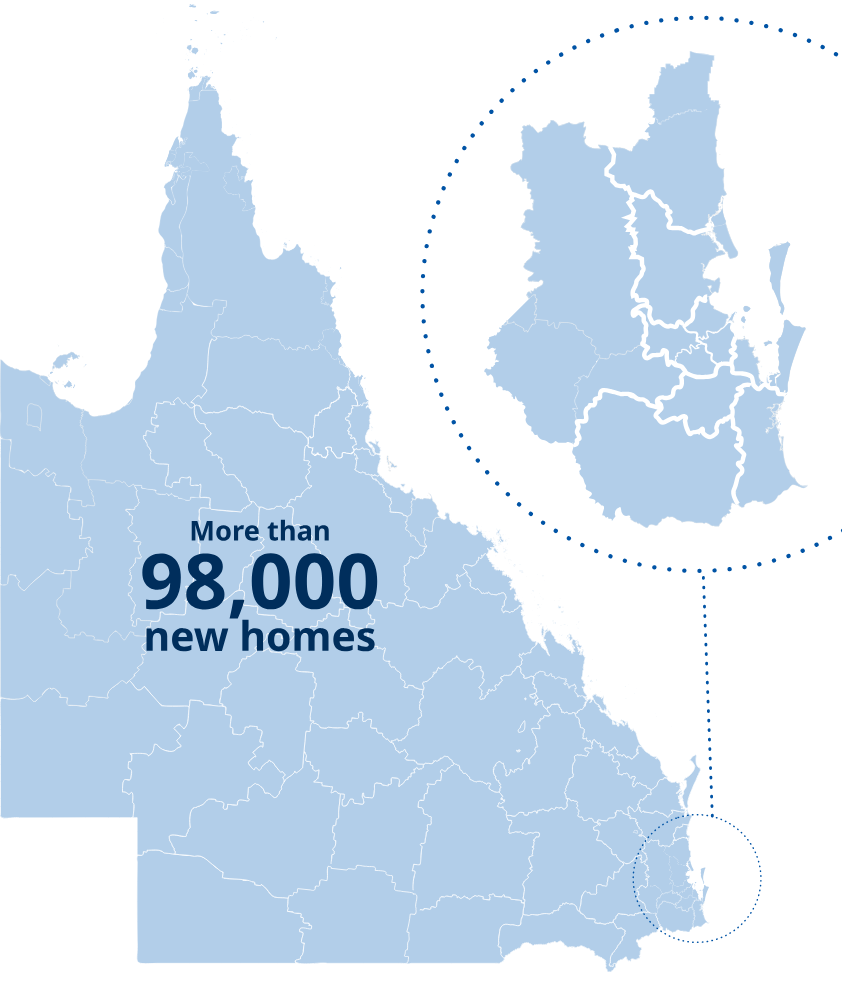
The Residential Activation Fund (RAF) provides up to $2 billion to deliver trunk infrastructure, including roads, water, power, and sewage, that enables new housing projects to proceed. As of 23 February 2026, Round 2 opened with $500 million available and introduced several important updates.
Round 2 continues the Fund’s core purpose: accelerating the delivery of critical infrastructure to activate both infill and greenfield residential developments across Queensland. Key changes include a priority for regional projects, with non–South East Queensland councils that secured Round 1 funding for Specific Infrastructure Planning Projects being prioritised for construction funding. Construction timing requirements have been tightened: projects must commence within 12 months of the public announcement of successful applications and be completed within three years.
The definition of Development Approval has also been broadened to include preliminary approvals, expanding eligibility for certain projects. Other updates include a reduced contingency cap of 20% and clarified definitions of trunk and essential infrastructure. Eligible activities remain focused on works necessary to enable residential development projects, including tendering, materials procurement, construction, commissioning, and certification.
Who it impacts and how
For developers and landowners, Round 2 provides an opportunity to remove infrastructure bottlenecks and accelerate housing delivery. Projects with approved DAs can leverage funding to ensure essential services are in place before construction begins. Local Governments, particularly in regional areas, can use the Fund to fast-track critical trunk and essential infrastructure, helping unlock housing supply more efficiently. By understanding the updated criteria and aligning applications with priority areas, stakeholders can reduce approval risks, meet tighter construction timelines, and maximise the impact of this funding on housing delivery.
What this means for industry stakeholders
Together, these reforms signal a shift toward clarity, coordination, and delivery-focused planning in Queensland. For developers, the changes create an environment where projects can progress with greater certainty. Understanding build-to-rent definitions, aligning with regional priorities, and exploring Residential Activation Fund opportunities can reduce approval risks and accelerate timelines. Early engagement with Local Governments and infrastructure planning helps anticipate requirements, address bottlenecks, and deliver projects efficiently.
Designers and architects now need to think beyond site-level compliance. Designs must consider regional strategies, infrastructure readiness, and community outcomes. Projects that align with regional priorities are more likely to gain approval and create developments that are resilient and well-integrated into their communities.
For architects and designers, the updated siting and design standards for community residences shift compliance earlier into the concept phase. Councils are likely to apply stricter assessment against neighbourhood integration, privacy controls, setbacks, and overall building form.
Ultimately, this reform is about reducing interpretation within the system. Projects that align early with the updated definitions and standards will experience smoother approvals. Projects that rely on flexible interpretations or late-stage redesign are more likely to encounter delays, additional reporting, and cost escalation.
The practical takeaway is clear: understanding the reforms, recognising who they impact, and planning accordingly will turn policy changes into tangible advantages for projects and communities in 2026 and beyond.
How Planna can help
At Planna, our focus is on making the planning process faster and more predictable for the people delivering projects. The planning system is often fragmented, with requirements scattered across legislation, regional plans, local schemes, and infrastructure frameworks. That complexity can slow down projects and introduce unnecessary risk during design and approval stages.
Planna helps streamline this process by bringing planning requirements, site constraints, and strategic considerations together in one place. Designers, architects, and developers can quickly understand what applies to a site, how proposals align with planning controls, and where potential issues may arise before an application is lodged.
In a changing regulatory environment like Queensland’s 2026 reforms, having that clarity early makes a significant difference. By reducing time spent navigating planning documents and reporting requirements, project teams can focus more on design, delivery, and decision-making.
The result is a planning process that works more like it should: informed early, coordinated properly, and far less reliant on time-consuming interpretation.
Read more


