
Statement of Environmental Effects NSW: A complete guide
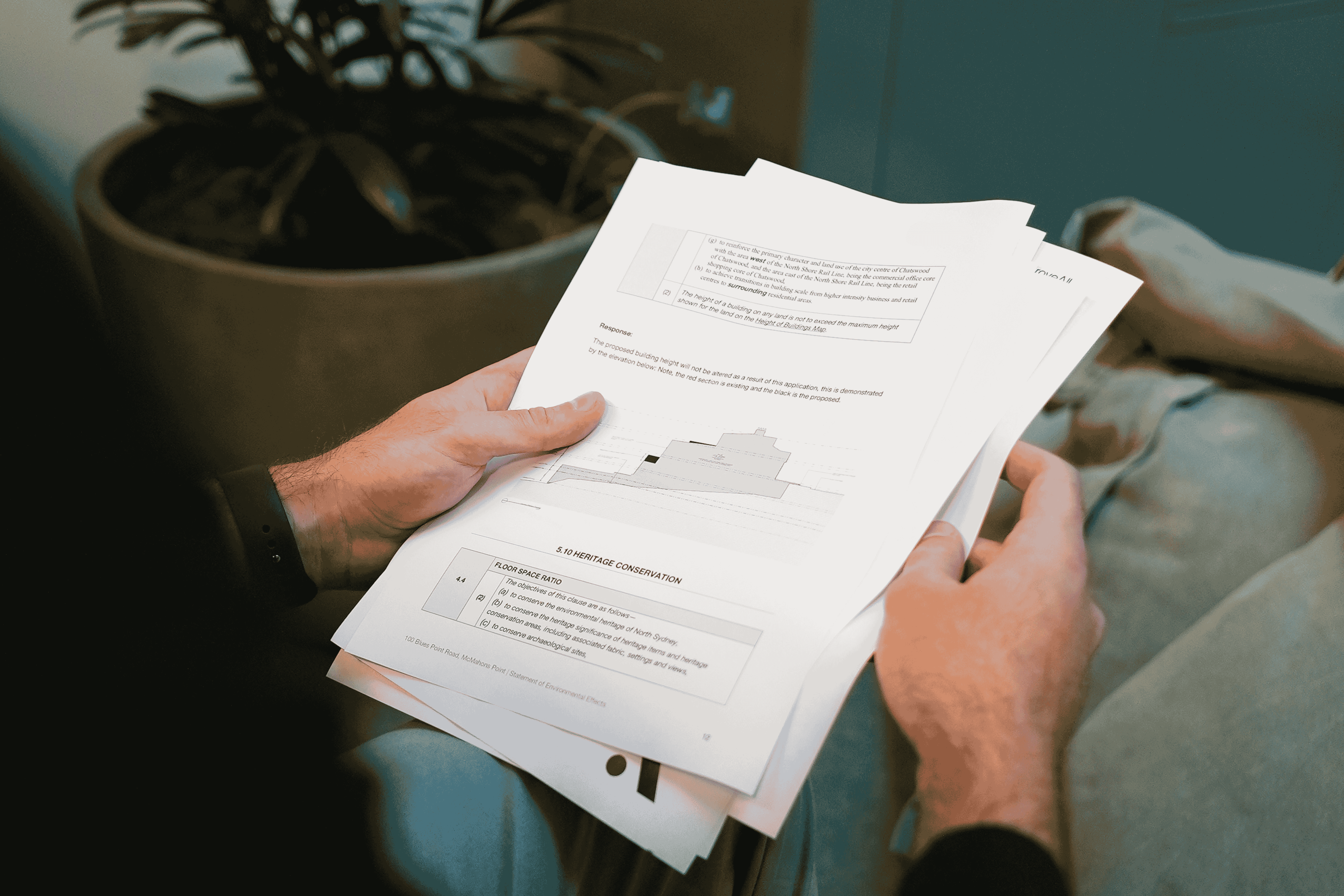
Navigating development in New South Wales can feel like a maze of regulations. Whether you are planning a new home, an extension or a commercial project, councils need to understand not just what you intend to build but how it affects its surroundings. That’s where a Statement of Environmental Effects (SEE) comes in.
This comprehensive document sits at the heart of most development applications in NSW and is required for all proposals that do not qualify as exempt or complying development. Yet many property owners only discover its importance after council delays or refusals.
In this guide you will learn:
- What a Statement of Environmental Effects is and why it matters
- When you need one and what happens if you don’t submit it
- Key components every SEE must include
- How to prepare a quality SEE and avoid common mistakes
- Who can write a SEE and how long it takes
- How modern tools like Planna can streamline the process
If you are preparing a development application (DA) in NSW, understanding the SEE will save you time, money and stress.

Understanding the Statement of Environmental Effects
What is a Statement of Environmental Effects?
A Statement of Environmental Effects (SEE) is a formal report submitted with a development application that outlines how your proposal will impact the natural and built environment, and how these impacts will be managed. It serves several functions:
- Project description: It translates your objectives into a language the consent authority can understand.
- Compliance assessment: It evaluates the proposal against State Environmental Planning Policies (SEPPs), Local Environmental Plans (LEPs) and Development Control Plans (DCPs).
- Planning justification: It identifies any non-compliances and explains why approval should still be granted.
- Regulatory considerations: It contextualises the proposal within the Environmental Planning and Assessment Act 1979 and demonstrates compliance with applicable environmental planning instruments and development control plans.
- Supporting evidence: It incorporates specialist reports and technical assessments to substantiate your case.
In NSW, Schedule 1 of the Environmental Planning and Assessment Regulation 2000 mandates that a SEE must accompany all development applications other than designated or State significant development. This makes it one of the most critical documents in the approval process. Without it, your application will not be assessed.
Purpose and Importance
Councils and other consent authorities use the SEE to answer two fundamental questions: What does the applicant want to do? And how will it affect the site and its surroundings? By clearly addressing these issues, the SEE:
- Provides transparency for council officers and the community.
- Demonstrates that you have considered environmental, social, and economic impacts.
- Shows how you will mitigate adverse effects.
- Speeds up the assessment process and reduces requests for additional information.
- Reduces the risk of objections or appeals by addressing potential concerns up front.
When Is a Statement of Environmental Effects Required?
Development types requiring a SEE
The requirement is broad. According to NSW councils, every DA, no matter how minor, must include a Statement of Environmental Effects. This includes amendments to existing consents (section 4.55 modifications). Examples of projects that usually require a SEE include:
- New building construction for residential, commercial or mixed-use developments.
- Major renovations or extensions that significantly alter the design or structure.
- Land-use changes, such as converting industrial land to a sports recreation facility use or food and drinks premises.
- Developments in sensitive areas, such as near heritage sites, coastal zones, bushland or waterways.
- Subdivisions, including Torrens title, strata or community title.
Certain minor works that qualify as exempt or complying development do not require a DA and therefore fall outside the SEE requirement, though you should confirm the applicable pathway with your council before proceeding.
Regulatory basis
Schedule 1 of the Environmental Planning and Assessment Regulation 2021 requires a SEE to accompany all development applications. The only projects that fall outside this requirement are those that qualify as exempt or complying development, which follow separate approval pathways. Councils including Lake Macquarie and Sutherland Shire emphasise this requirement in their lodgement guidelines.
Consequences of not submitting a SEE
Failing to provide a SEE or submitting an inadequate one can have serious consequences. Councils may refuse to accept your application or request further information, which leads to:
- Immediate rejection of the DA, which stays on your property’s DA history.
- Delays in project approval while you compile the missing information.
- Additional costs for resubmission and revised reports.
- Increased risk of refusal if the issues cannot be adequately resolved.
Councils also warn that an incomplete SEE will delay processing, most councils have a pre-lodgement checklist which they will not let you pass and lodge your DA without fulfilling all items, the SEE is top of the list. Submitting a thorough document from the outset is therefore critical.
Beyond regulatory compliance, a well-prepared SEE offers several benefits:
1. Demonstrates due diligence
A SEE shows that you have systematically considered the environmental, social and economic impacts of your proposal and taken steps to mitigate them. This reassures council officers and neighbours that your development is responsible and compliant.
2. Simplifies council assessment
Clear information speeds up the assessment process. Councils often request additional information when key details are missing or unclear. By covering the site description, proposed works, impacts, mitigation and compliance up front, you minimise back-and-forth and shorten determination times.
3. Reduces the risk of objections
Communities are more likely to support or at least not oppose proposals that demonstrate awareness of local impacts. A transparent SEE can pre-empt concerns and show how you plan to mitigate issues such as traffic, noise, heritage or biodiversity impacts.
4. Offers planning justification
Sometimes projects depart from specific planning controls. A SEE provides the opportunity to justify these variations and explain why approval should still be granted.
5. Forms a reference throughout construction
Once consent is granted, conditions often reference the SEE. Having a detailed, accurate SEE helps ensure that construction and operation remain consistent with the approved design and mitigations.
What to Include in Your Statement of Environmental Effects
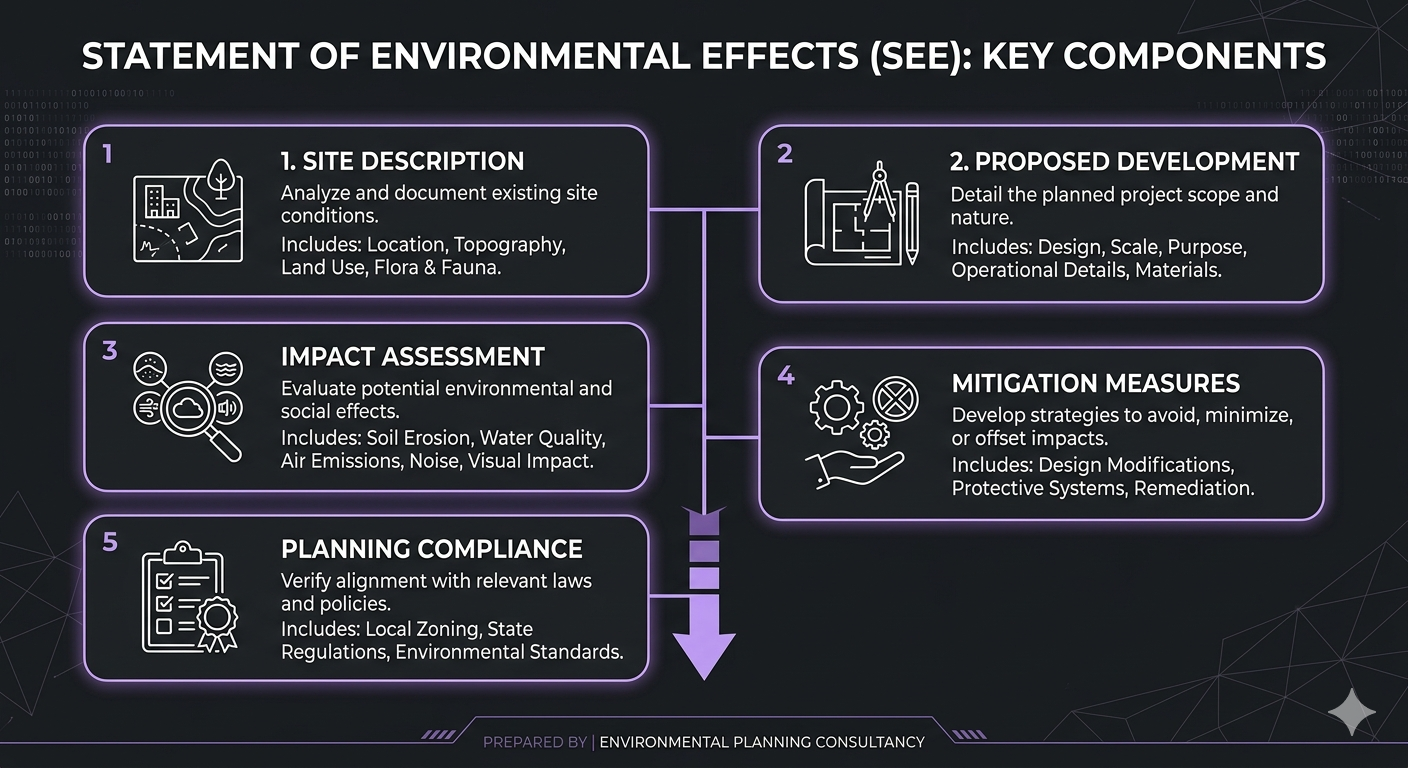
The Environmental Planning and Assessment Regulation and council guidelines outline minimum content requirements. A comprehensive SEE should include the following sections:
1. Site description

Describe the site’s location, size, topography, existing structures and uses, and the surrounding context. Include relevant environmental features such as vegetation, waterways, flood zones or heritage items. Councils expect you to discuss present and previous land uses.
2. Detailed description of the proposed development
Provide clear, concise information about what you want to build or modify, including dimensions, materials, operations and staging. For apartment buildings and complex developments, the regulation requires additional details such as design quality principles, drawings of the proposal in context, compliance with height and setback controls, landscape plans, façade materials and even photomontages.
3. Site suitability
Discuss why the site is suitable for the proposed use. This might cover zoning compliance, access, services and any constraints or benefits.
4. Assessment of environmental impacts
Identify likely impacts on the natural and built environment, including social and economic effects. Councils expect you to explain how the impacts have been identified and to address both construction and operational phases.
Key impact categories may include:
- Amenity (overshadowing, privacy, views)
- Traffic and parking
- Noise and vibration
- Heritage and character
- Flora and fauna
- Water quality and stormwater
- Air quality and dust
- Waste management
5. Mitigation measures
Explain the steps you will take to avoid, minimise or manage impacts. This could involve design modifications, construction management plans, landscaping, acoustic treatments, traffic management, erosion controls or environmental monitoring. Detail how these measures address both short- and long-term effects.
6. Planning compliance
Demonstrate how the proposal complies with relevant planning instruments, such as SEPPs, LEPs, DCPs and State legislation. Include a compliance matrix that lists each relevant clause and shows whether the proposal meets or deviates from it. Where non-compliances exist, provide justification supported by planning principles or precedents.
7. Supporting documentation
Attach or reference specialist reports such as:
- Bushfire assessments, flood studies, geotechnical reports
- Building Code of Australia (BCA) compliance reports
- Heritage impact statements
- Waste management plans
- Noise and traffic impact assessments
- Engineering designs or stormwater management plans
Make sure all plans, elevations and perspectives are consistent and clearly labelled. Councils often reject or delay applications when documents conflict.
Step by Step: How to Prepare a Statement of Environmental Effects
Writing a high-quality SEE involves more than filling out a template. The following steps will help you organise your report:
- Research the planning framework: Identify the SEPPs, LEPs, DCPs and any State codes that apply to your site. Local environmental plans and development control plans can be obtained from your council’s website or planning portal.
- Analyse the site: Conduct a detailed site analysis, including land uses, constraints, opportunities, heritage items and environmental features. For home extensions, this might involve examining boundaries, slopes and access points.
- Engage specialists if needed: Early engagement with planners, engineers or bushfire consultants can help identify issues and provide input into design solutions. Councils encourage applicants to contact their duty planners for advice.
- Develop a compliant design: Work with your architect or designer to align the proposal with planning controls. Tools like Planna can run pre-checks to ensure your design meets setback, height and floor space requirements before you invest in detailed drawings.
- Assess impacts and develop mitigation: Identify potential impacts during construction and operation. Document how you will manage each impact through design changes, construction management plans or ongoing operational measures.
- Prepare the written SEE: Use council templates or your own structure. Cover the topics outlined above, referencing relevant planning clauses, maps and diagrams. Provide justification for any non-compliances and cross-reference supporting reports.
- Review and quality-check: Ensure that all plans and reports are consistent and that the SEE addresses every clause in the LEP, DCP and SEPPs. Inconsistent documents are a major cause of council requests for further information.
- Submit via the NSW Planning Portal: All DAs in NSW must now be lodged electronically through the NSW Planning Portal. Upload your SEE and supporting documents in the required format. Keep copies for your records.
Who Can Prepare a Statement of Environmental Effects?
DIY vs professional preparation
Technically, anyone can prepare a SEE. Councils often provide templates for minor developments or simple alterations. However, preparing a high-quality SEE requires a solid grasp of planning law, environmental assessment and report writing.
For straightforward residential projects, you might feel comfortable completing the SEE yourself using a template and council guidance. In fact, modern tools like Planna allow architects and homeowners to generate a draft SEE quickly and then have it reviewed by qualified planners before submission, helping to save time and reduce costs.
For more complex projects (multi-dwelling developments, projects in sensitive areas or proposals involving non-compliances) it is wise to engage a professional town planner or environmental consultant. Councils like Lake Macquarie note that while anyone can prepare a SEE, applicants should consider hiring a professional for projects relying on existing use rights or involving complex environmental issues.
Expertise matters
Experienced planners and consultants bring benefits:
- Strategic advice: They identify risks early and suggest design changes to improve approval chances.
- Comprehensive reports: Professionals know how to structure the SEE, address all relevant clauses and support your case with evidence.
- Saving time: They streamline the process by anticipating council queries and providing complete, consistent documentation.
- Advocacy: They can liaise with council on your behalf, respond to requests for further information and negotiate conditions.
Costs and Timeframes
How much does a SEE cost?
The cost of preparing a Statement of Environmental Effects varies widely. For simple projects, using a council template or automated service may cost only a few hundred dollars. For more complex developments requiring multiple specialists and detailed analysis, fees can reach several thousand dollars.
Using an automated platform like Planna can reduce costs because you prepare much of the material yourself and pay only for expert review.
How long does it take?
Timeframes also depend on complexity. Deep River suggests that preparing a well researched SEE can take anywhere from 20 to 1,000+ hours. That wide range reflects the scale of projects, ranging from minor alterations to multi-building developments.
Consultants like Auswide estimate they can prepare a SEE in 5-10 working days, while Deep River emphasises that their team often involves multiple specialists to speed up the process. Automated platforms can significantly cut down drafting time for standard sections, but you should still allow time for specialist reports, design tweaks and council feedback.
Common Mistakes and How to Avoid Them
Even experienced applicants can overlook key details in a SEE. Avoid these pitfalls:
- Incomplete or inconsistent documentation: Missing plans, mismatched drawings or inconsistent text are common reasons for council requests for further information. Cross-check all documents before submission.
- Ignoring environmental or social impacts: Councils expect you to address both environmental and social impacts. Failing to discuss traffic, noise or heritage impacts can lead to delays or refusal.
- Not addressing planning controls: A SEE must explain how the proposal complies with relevant SEPPs, LEPs and DCPs or justify any non-compliances. Use a compliance matrix to systematically address each clause.
- Underestimating mitigation: Simply identifying impacts is not enough. Explain the steps you will take to mitigate them and reference supporting management plans.
- Late engagement of specialists: Waiting until the final draft to commission specialist reports often leads to extra cost and time. Engage consultants early so their findings can shape the design and SEE.
- Lack of community consultation: Although not required, talking to neighbours and community stakeholders can be seen to reduce objections. Consider including a summary of community feedback and how you addressed concerns.
Streamlining with Digital Tools
Advances in proptech make preparing a SEE faster and more affordable. Planna, for example, provides automated report generation with expert review. Here’s how it helps:
- Pre-assessment checks: The platform analyses planning controls for feasibility of the proposal and identifies which pathway your project must follow (exempt, complying or DA). This avoids unnecessary reports.
- Smart templates: Automated tools generate draft SEEs based on your inputs and property data. You can then refine the document and add project-specific details before submitting it for professional review.
- Expert oversight: Qualified ex-council planners review the draft in detail to ensure accuracy and compliance. This blends the efficiency of automation with the assurance of professional insight.
- Faster turnaround: Automated systems can deliver expert-reviewed SEE reports within 48-72 hours, far quicker than traditional consultancy timeframes.
For small to medium projects, these tools reduce cost and turnaround time. For complex projects, they provide a strong starting point, supplemented with bespoke planning advice and other specialist reports.
Conclusion & Next Steps
A Statement of Environmental Effects is more than a bureaucratic requirement. It is your opportunity to demonstrate that your project is thoughtfully designed, compliant with planning controls and considerate of environmental and social impacts.
In NSW, almost all development applications require a SEE. A well-prepared statement:
- explains what you intend to do;
- shows how you identified and mitigated impacts;
- demonstrates compliance with planning instruments; and
- supports any justification needed for variations.
Whether you choose to prepare the SEE yourself, use an automated platform or engage a professional planner, invest the time to research, analyse and document thoroughly. Doing so will make the council’s assessment smoother, reduce delays and increase the likelihood of approval.
If you are unsure where to start, Planna offers a hybrid solution that combines smart automation with expert review. And for more detailed guidance on the development approval process, see our related articles on NSW planning approvals, avoiding common DA roadblocks and when you need a town planner.
FAQ
What is a Statement of Environmental Effects in NSW?
A Statement of Environmental Effects is a document that accompanies most development applications. It explains your proposal, assesses environmental and social impacts, describes mitigation measures and demonstrates compliance with planning laws.
Do I need a SEE for a minor renovation?
Yes. Councils such as Sutherland Shire state that a SEE is required for every development application, no matter how minor. Only certain complying development projects are exempt.
What happens if I submit a DA without a SEE?
Your application will be considered incomplete. Councils can refuse to accept it or will request further information, leading to delays, extra costs and a higher risk of refusal.
What should be included in a SEE?
At minimum, the SEE should describe your site and proposal, assess environmental impacts, explain mitigation measures, demonstrate compliance with planning instruments and justify any variations. For apartment buildings or complex projects, additional details such as design quality, landscape plans and photomontages may be required.
Can I write my own SEE?
Yes. Anyone can prepare a SEE, and many councils provide templates. For simple projects, using a template or an automated platform like Planna may suffice. However, for complex proposals or developments with non-compliances, engaging a professional planner or consultant is strongly recommended.
How long does it take to prepare a SEE?
Preparation times vary from a few days to several months. Consultants like Auswide estimate 5-10 working days for a typical report, while Deep River notes that complex projects can require 20-1,000+ hours of work.
How much does a SEE cost?
Costs range from a few hundred dollars for simple reports using templates to several thousand dollars for complex projects with multiple specialist reports. Automated platforms can reduce costs by handling routine sections and leaving only final review to professionals.
Read more


