
Planning for resilience: how Australia's cities can respond to the fuel crisis
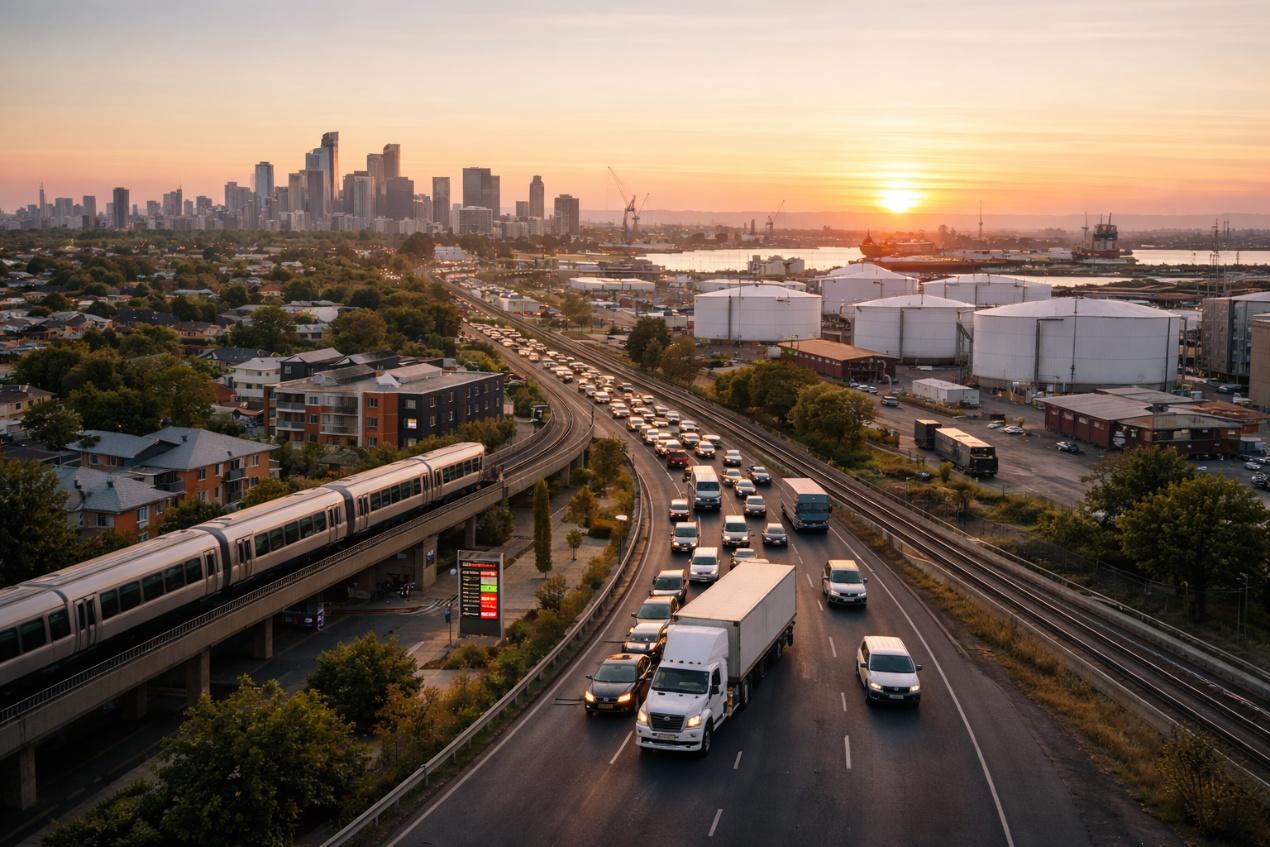
When conflict escalated in the Middle East in February and threatened flows through the Strait of Hormuz, a vulnerability that energy analysts had flagged for years became impossible to ignore. IEEFA described it as the largest supply disruption in the history of the global oil market. Tanker shipments were cancelled. More than 107 fuel stations across NSW ran out of diesel in March. The federal government released emergency reserves, relaxed fuel standards, and appointed a national coordinator. These are the right short-term responses. But they do not touch the underlying condition that makes Australians so exposed every time global supply tightens.
According to OilPrice.com, Australia imports around 90% of its liquid fuel and holds just 37 days of petrol and 30 days of diesel in reserve, well below the IEA’s recommended 90-day minimum. The transport sector alone accounts for roughly 75% of total national fuel demand. That figure is why this is a planning conversation as much as an energy one. The conditions that make Australians so dependent on fuel are shaped almost entirely by decisions made at state and local planning level: where they live, how far they travel, whether any alternative to driving exists.
A car dependency built by planning
Australia's car dependency is often attributed to geography, but research from the University of Melbourne points more directly at planning. After decades of sprawling, residential-only development on urban fringes, more than 72% of Australians now rely on private vehicles for daily trips. Families in greenfield estates have no realistic alternative to driving. When fuel prices spike, they absorb it entirely. RMIT's Professor Jago Dodson has noted that most trips within Australian cities are under five kilometres. These are distances that are walkable or cyclable, if the urban environment was ever built to allow it. For most outer-suburban residents, it simply was not.
The trend is also moving in the wrong direction. In January 2025, SUVs and light commercial vehicles made up 83% of new car sales in Australia. These are heavier, less fuel-efficient vehicles predominantly used for urban driving. As SBS News reported, experts now describe the crisis as a wake-up call for Australia to rethink how it uses and structurally demands fuel. The planning environment that normalises car use for every trip quietly enables that demand. The current crisis makes the cost of that explicit.
What planning can change
Density and mixed use are the most direct levers available to the planning system. When development is approved close to services such as schools, retail, medical and employment, trip lengths shorten and public transport investment becomes viable. At the state level, the policy direction is largely right. NSW's Transport Oriented Development program rezones land within walking distance of rail stations for medium-to-high density mixed use, directly targeting the sprawl pattern that underpins vehicle dependency. Victoria's Plan Melbourne and Queensland's ShapingSEQ carry similar intent around activity centres and 20-minute neighbourhoods.
The gap is local implementation. Councils regularly apply their own planning schemes in ways that work against state-level intent, capping density well below what TOD precincts are designed to support, or preserving single-use residential on sites within walking distance of major train stations. Well-located infill opportunities remain underdeveloped, and growth pressure continues to push outward rather than consolidating where infrastructure already exists.
Industrial and logistics land is the other issue this crisis brings into focus. As the CPD Centre has documented, Australia's supply chains are already under acute pressure from the fuel shock, and freight operations that have been pushed further from ports and rail corridors are bearing disproportionate cost. Australia has a pattern of rezoning strategically located employment and freight land to residential uses. The short-term land value argument is easy to make. What gets less scrutiny is the supply chain consequence: more truck kilometres, more diesel consumed, and less buffer when global supply tightens.
What this means for projects in the system now
At Planna, we are already seeing transport carry more weight in planning assessments, covering not just parking and traffic generation but trip length, mode share, and how a project sits relative to existing services and transit. That shift was underway before the crisis. The current climate is sharpening it and giving it concrete economic grounding.
For residential projects, walkability and transit access are becoming genuine merit arguments rather than marketing language. State policy across most jurisdictions explicitly supports transit-oriented development. Applicants who can demonstrate, with real evidence about proximity, connectivity, and mode options, how their project reduces vehicle dependency are in a stronger position before decision-makers than they were twelve months ago.
For industrial and mixed-use projects near freight corridors, the case for protecting or activating those locations has also strengthened. Planning authorities now have a concrete economic reason to take strategic freight land seriously. That is worth factoring into how those applications are framed.
The longer view
Planning will not resolve a global supply disruption. But it can, over time, reduce how exposed Australian communities are to the next one. As IEEFA observed in March 2026, despite repeated warnings, governments on both sides have failed to address Australia's structural vulnerability. Planning reform is not a substitute for energy policy or reserve stockpiling, but the decisions being made in planning committees, at panel hearings, and in strategy documents right now are either building or foreclosing long-term resilience.
The 2026 crisis, as The Times of Australia noted, is not just a temporary disruption. It is the result of long-term structural decisions. The planning system is part of those decisions. The argument for denser, better-connected urban form has never been easier to make. For planners, applicants, and decision-makers working through the system right now, that context is worth using.
Read more


