
Tasmania's granny flat decision is bigger than it looks

We couldn’t find a home to renovate, so we built one in our garden.
Tasmania recently announced it will increase the maximum size of secondary dwellings from 60m² to 90m². It's a planning amendment. It won't make the front page. But for anyone working in housing policy or residential development, it's worth paying attention to.
The change is straightforward. Tasmanians will soon be able to build a granny flat that is 50% larger than what was previously permitted. Housing and Planning Minister Kerry Vincent has framed it as a way to support families embracing medium-density living, keeping multiple generations closer together without the need for separate properties.
That's reasonable framing. But the implications stretch further than family living arrangements.
No national standard, no consistency
Before getting into why this matters, it's worth understanding the landscape Tasmania is operating in.
There is no national standard for secondary dwellings in Australia. Each state sets its own rules, and in some cases those rules are further fractured at the local government level. The result is a system that is difficult to navigate and inconsistent in what it allows.
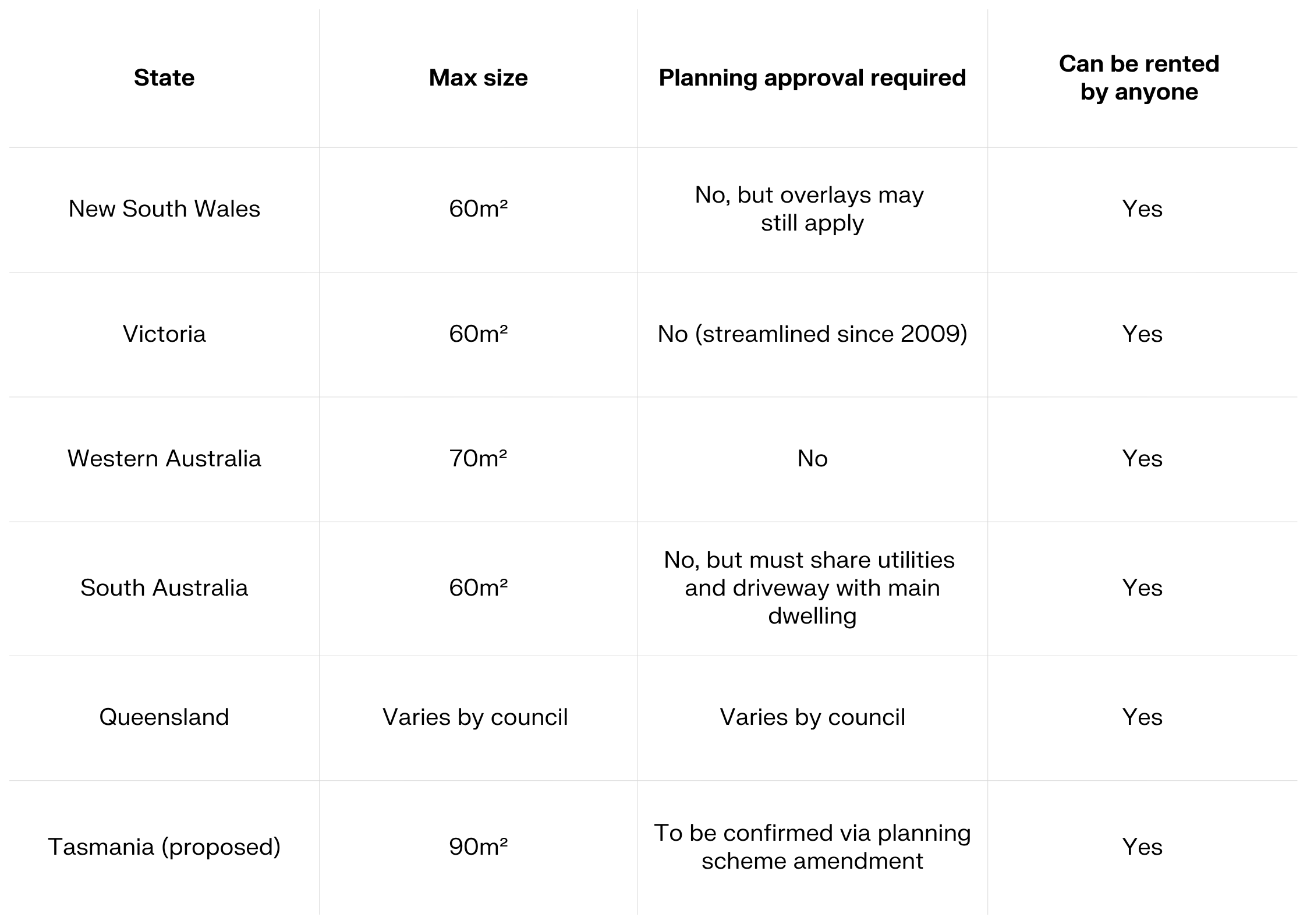
The inconsistency across jurisdictions isn't just an administrative inconvenience. It creates genuine uncertainty for homeowners, builders, and designers trying to work across state lines. It also means that the potential of secondary dwellings as a housing supply tool is being realised unevenly across the country.
Why size actually matters here
60 square metres sounds workable on paper. In practice, it's tight. A 60m² dwelling can accommodate a bedroom (we even see some clients pushing for 2), a bathroom, a small kitchen and a living area, but there isn't much room to move beyond that. It limits who the dwelling works for and, by extension, limits its usefulness in the rental market.
At 90m², there's enough floor area to design something genuinely liveable. A second bedroom becomes easily workable and not constrained. The kitchen and living spaces can breathe. The dwelling starts to function less like a converted studio and more like an actual home.
This distinction matters because the profile of who uses secondary dwellings is changing. The traditional image of an ageing parent living behind the family home is still part of the picture as they are widely known as ‘granny flats’ after all, but it's no longer the whole story. Secondary dwellings are increasingly being used by adult children, young couples, and renters with no family connection to the main dwelling at all. The more functional the dwelling, the broader the range of people it can genuinely house.
The rental affordability angle
Tasmania's housing market has been under pressure for some time. Hobart's rental vacancy rate currently sits at 0.3%, which by any measure is extremely tight. At that level, renters have almost no negotiating power and very little choice.
Secondary dwellings are not a silver bullet for rental affordability. They won't replace the need for broader housing supply reform, and they won't help people who are trying to get into the market as buyers. But they do add stock in locations that are already established, already serviced, and already connected to jobs and services. That's not a small thing.
The other advantage is that secondary dwellings increase density in a way that tends not to generate the same community resistance as larger infill developments. Adding a well-designed dwelling behind an existing home looks and feels different to a six-storey apartment building on a suburban corner. The scale is familiar. The impact on the streetscape is limited. For councils and communities that have historically been resistant to density, secondary dwellings offer a more palatable path forward.
There's also a practical case for proper regulation. When the rules are clear, people build to standard. When the rules are ambiguous or the process is too complicated, some will proceed without approval, which creates its own set of problems around building quality, safety and neighbourhood amenity. Expanding what's permitted while keeping the pathway simple is a more effective outcome than setting tight limits that get worked around.
Will the rest of Australia follow?
That's the question worth watching.
Tasmania is a small state with a relatively contained planning system, which makes it easier to move quickly on amendments like this. The larger states have more complex political and bureaucratic environments, and changes to residential planning controls rarely happen without significant stakeholder consultation.
That said, the housing affordability pressure being felt in Hobart is not unique to Tasmania. Melbourne, Sydney, Brisbane and Perth are all dealing with constrained rental markets and growing demand. The policy rationale for increasing secondary dwelling limits applies just as much in those cities as it does in Hobart.
NSW in particular is worth watching. Having led the country on secondary dwelling reform back in 2009, it hasn't revisited the size cap in a meaningful way since. With the state government under sustained pressure on housing supply, there may be an appetite to look at this again.
A national conversation about minimum standards for secondary dwellings is probably overdue. Not a rigid framework that ignores local context, but a baseline that removes the most unnecessary barriers and gives homeowners, builders and planners a clearer starting point regardless of where they're working.
Tasmania hasn't solved the housing crisis. But it has made a sensible, low-disruption decision that deserves more attention than it's getting.
Read more


