
Granny flats and dual occupancies in NSW: why preparation now matters more
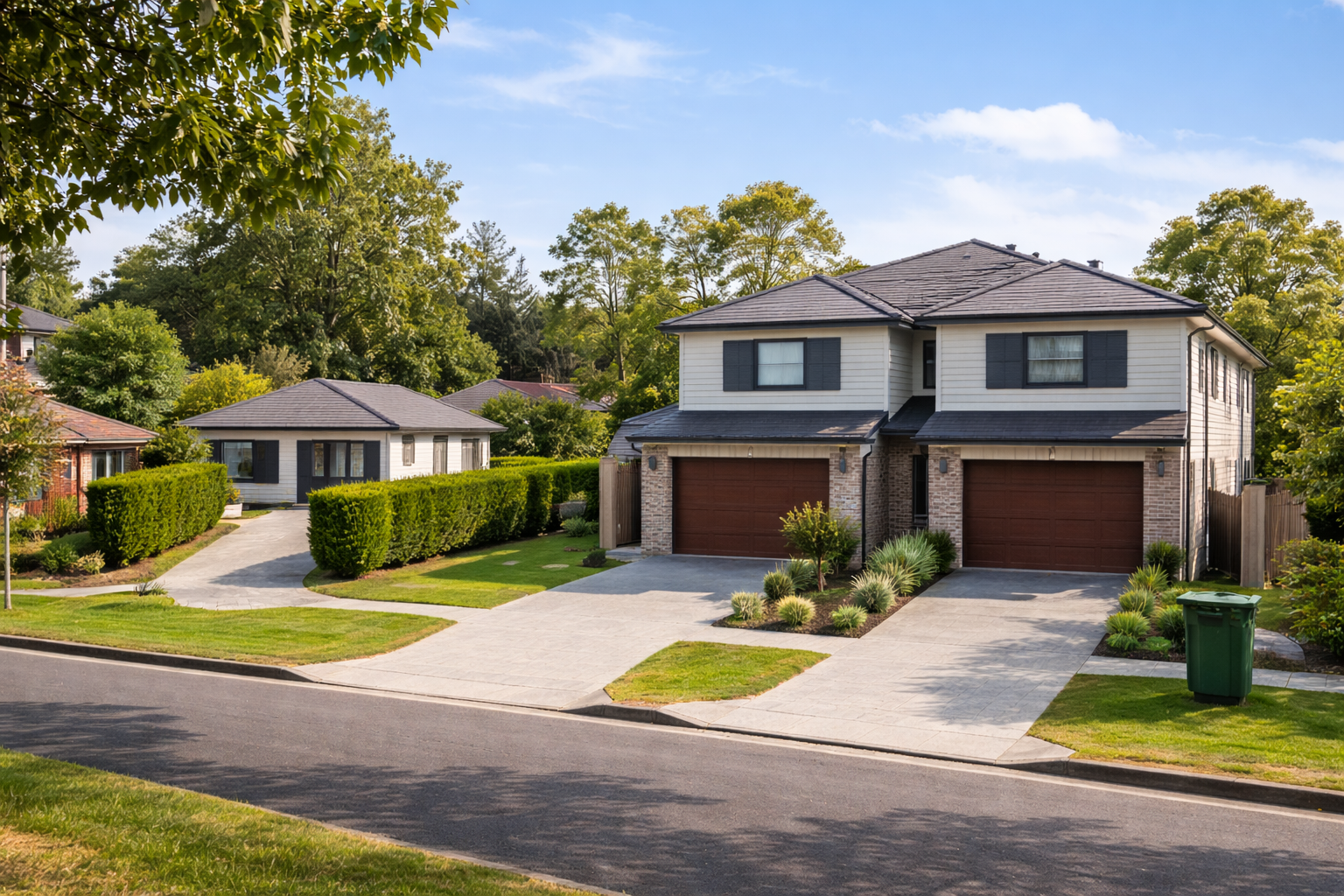
We have been asked these questions more in the past six months than at any other time.
Can I still build a granny flat?
Has dual occupancy become harder?
Did the recent changes to State Environmental Planning Policies (SEPP) shut this down?
The short answer is no. Both granny flats and dual occupancies remain supported under the NSW planning framework. The Housing SEPP continues to contemplate these housing types across many residential zones. What has shifted in 2026 is not permissibility, but expectations. Councils are looking for greater clarity earlier in the process.
The conversation has moved beyond what the rules allow in principle. The focus now is on how proposals perform in practice.
Why this question keeps coming up
Over the past year, planning reform has focused heavily on accelerating housing supply. Non-discretionary standards and clearer housing typologies were introduced to align assessment effort with actual planning risk. We wrote recently about how the 2025 reforms are playing out in day-to-day applications, and this is one of the areas where those shifts are most visible.
In practice, councils are applying a more front-loaded approach. They are filtering uncertainty at lodgement rather than resolving it during assessment. Applications that clearly address zoning, overlays, and variation logic tend to progress. Applications that rely on assumptions or generic planning reports are being challenged sooner. We are not seeing these projects rejected en masse. We are seeing them slowed down where the fundamentals are loose.
Granny flats remain the lower-risk pathway
Detached secondary dwellings continue to be one of the more straightforward forms of infill housing in NSW. In many residential zones, they are permitted with consent and may qualify as complying development where standards are met. For relatively unconstrained sites, the pathway is still efficient.
What has changed is the level of scrutiny applied to detail. Access widths under 3 metres, tight side setbacks and private open space that technically complies but feels compromised are being interrogated early. Flood and bushfire overlays that were once addressed later in the process are now expected to be understood at the feasibility stage. A proposal may be permissible in theory, but it still needs to demonstrate that it works within the physical constraints of the site.
The smoother projects are those where permissibility, lot size, overlays, and servicing capacity have been confirmed before design is finalised. When design leads, and planning follows, relatively minor compliance gaps can trigger avoidable redesign.

Dual occupancies are still supported, but less forgiving
Dual occupancies remain clearly contemplated in many residential zones and reinforced through the Housing SEPP framework. Non-discretionary standards were intended to reduce debate around core metrics such as height and setbacks, and where proposals genuinely meet those standards, assessment can move efficiently.
However, dual occupancies change the built form more significantly than most secondary dwellings. In established lower-density residential suburbs, we are still seeing character reasoning used to interrogate bulk and articulation, even where numerical standards are met. Numeric compliance alone is not always persuasive. Councils want to see how the proposal responds to the rhythm of the street, the scale of adjoining dwellings, and the prevailing setbacks.
Servicing and infrastructure issues also surface earlier. Stormwater capacity on narrow battle-axe lots has become a recurring friction point. Shared driveways that technically comply but feel constrained in practice are being questioned. Waste collection points that are workable on paper are being tested against real site conditions. None of this means dual occupancies are discouraged. It does mean the margin for loose preparation is narrower.
CDC versus DA is a strategic decision
There is a common assumption that if a proposal qualifies as complying development, it is automatically the safest option. For clean, flat, and unconstrained sites, that may be true. A Complying Development Certificate can provide certainty and speed.
More complex sites require a more careful judgement. Where overlays apply, lot dimensions are irregular or minor variations are likely, a development application can offer flexibility that a CDC cannot. Once a CDC is issued, there is limited scope to adjust. The choice is less about speed and more about understanding site specific risk before committing to a pathway.
Where delays are still occurring in 2026
Despite reform, the causes of delay are familiar. Overlays are not fully understood at the feasibility stage. Lot size assumptions that do not reflect the actual zoning map. Architectural drawings that show one site coverage figure while the planning report references another.
We are also seeing avoidable delay where variations are raised but not clearly framed against planning objectives. Councils appear more willing to move efficiently where the fundamentals are clearly addressed. They are less inclined to resolve basic uncertainty during assessment. The system can move faster, but it still relies on preparation.
Where town planners fit in
This shift toward front-loaded clarity is where we see the greatest value at Planna. Increasingly, we are engaged before design is locked in. Preliminary planning reports allow zoning, overlays, Housing SEPP standards, and assessment pathway risk to be tested early.
By resolving permissibility and variation logic at the feasibility stage, clients can make informed decisions about whether to pursue a granny flat, a dual occupancy, or an alternative configuration. This reduces the risk of committing to a design that later proves difficult to justify and ensures the chosen pathway aligns with the site’s actual constraints.
When it comes time to lodge, a clear and structured planning report that directly addresses the relevant controls and site conditions reduces friction during assessment. The heavy lifting has already been done. Reform has created clearer pathways, but outcomes are still shaped by preparation.
What this means for 2026 projects
If you are considering building a granny flat or dual occupancy in NSW, the key question is not simply whether the SEPP allows it in principle. In many residential zones, it does.
The more important question is how your specific site interacts with that framework. Is the zoning permissive? Are there flood, bushfire or heritage overlays? Does the existing built form leave sufficient site coverage and open space? Is access compliant? Does the proposal rely on variations that require careful framing? These are practical planning questions. They determine whether a project proceeds smoothly or becomes an iterative redesign exercise.
Final thoughts
The 2026 planning framework remains broadly supportive of both granny flats and dual occupancies. Policy has not shut these housing types down. What has changed is the expectation that the fundamentals are resolved early and clearly.
Planning reform has created clearer pathways, but it has not replaced professional judgement. If the question is whether you can still build a granny flat or dual occupancy in NSW, the answer is yes. The projects that move in 2026 are the ones where the groundwork was done early, where zoning, overlays and variation risk were tested before design was locked in. That is the real shift.
Read more


